
Pathophysiology of Acute and Chronic Cellular Inflammation in 2026
Inflammation represents an evolutionary preserved physiological response designed to protect the human organism against pathogen invasion, tissue trauma, and chemical insults. While acute inflammation functions as an orchestrated, self-limiting defense mechanism, chronic low-grade systemic inflammation acts as an insidious driver of degenerative tissue breakdown, vascular stiffness, metabolic dysfunction, and reproductive organ dysregulation.
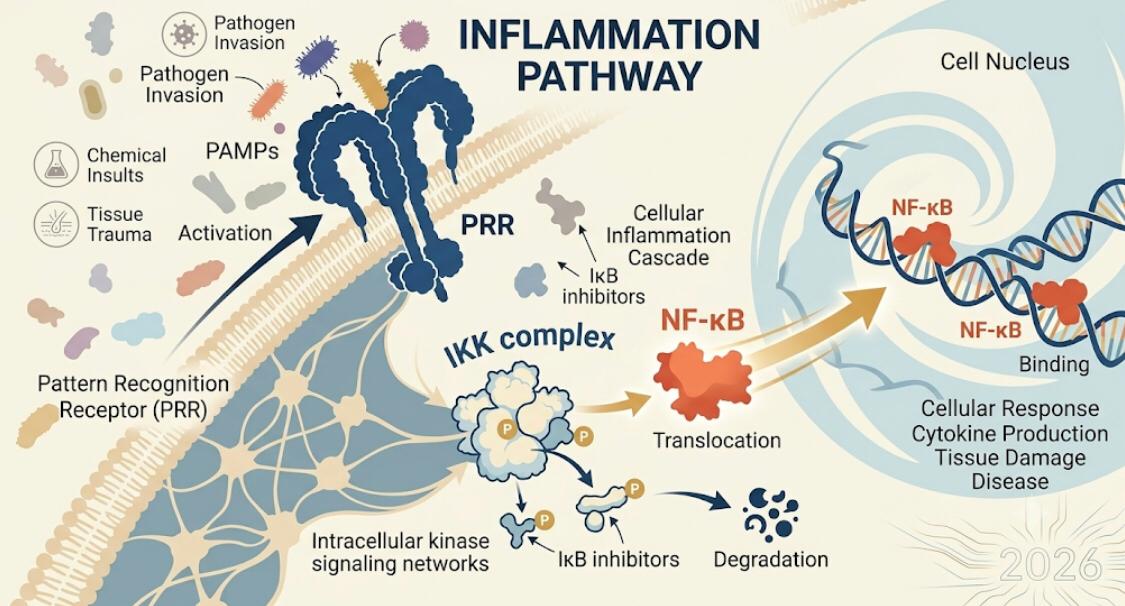
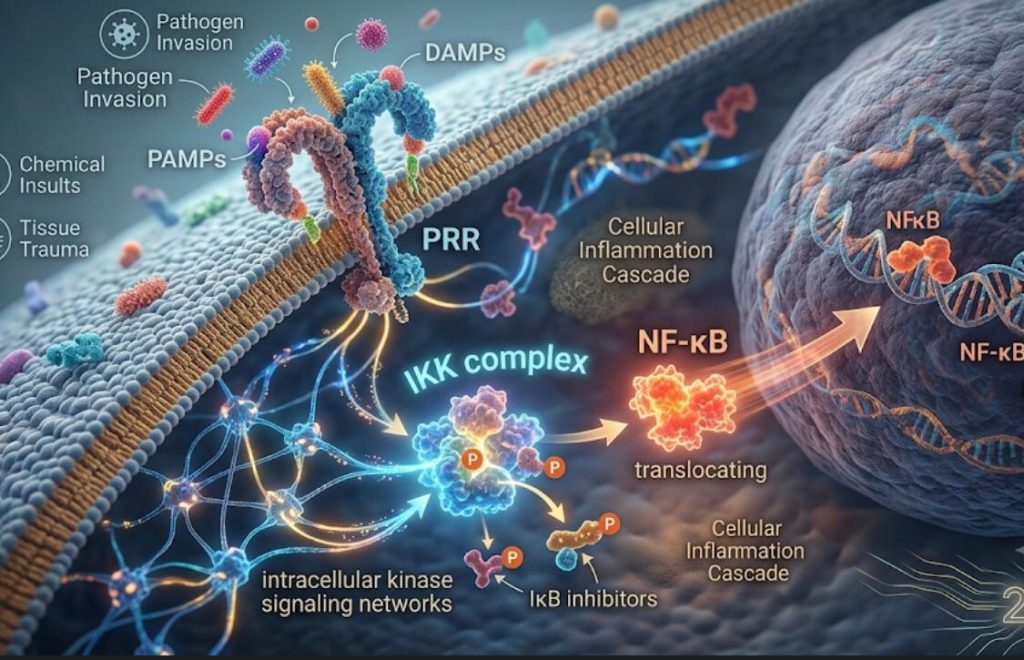
The acute inflammatory cascade initiates when pattern recognition receptors (PRRs), such as Toll-like receptors (TLRs), detect pathogen-associated molecular patterns (PAMPs) or damage-associated molecular patterns (DAMPs) released by injured cells. Receptor engagement triggers intracellular kinase signaling networks including the IκB kinase (IKK) complex driving the phosphorylation and degradation of IκB inhibitors. This liberates nuclear factor kappa B (NF-κB) to translocate from the cytoplasm into the cell nucleus.
Endothelial Activation and Neutrophil Extravasation
Once inside the nucleus, NF-κB transcriptionally upregulates pro-inflammatory cytokines, including tumor necrosis factor-alpha (TNF-$\alpha$), interleukin-1 beta (IL-1$\beta$), and interleukin-6 (IL-6). These cytokines induce structural alterations in adjacent microvascular endothelial cells. Selectins (E-selectin, P-selectin) expressed on activated endothelium mediate weak rolling interactions with circulating polymorphonuclear neutrophils (PMNs).
Integrin Activation and Transendothelial Migration
Subsequent activation of neutrophil integrins specifically macrophage-1 antigen (Mac-1) and leukocyte function-associated antigen-1 (LFA-1) promotes high-affinity binding to endothelial intercellular adhesion molecule-1 (ICAM-1). Neutrophils undergo diapedesis across the vascular wall, following chemotactic gradients of interleukin-8 (IL-8) and leukotriene to reach the site of tissue injury, where they execute phagocytosis and release reactive oxygen species.
When acute noxious stimuli persist, or clearance mechanisms fail, the cellular infiltrate shifts from short-lived neutrophils to monocyte-derived macrophages and T lymphocytes. Chronic inflammation is characterized by continuous tissue destruction occurring simultaneously with frustrated attempts at cellular repair.
Pro-inflammatory M1 vs. Pro-resolving M2 Macrophage Phenotypes
Macrophages display remarkable plasticity, operating along a spectrum defined by two primary activation states:
- M1 Macrophages (Classically Activated): Induced by interferon-gamma (IFN-$\gamma$) and bacterial lipopolysaccharide (LPS). M1 macrophages produce high levels of inducible nitric oxide synthase (iNOS), ROS, TNF-$\alpha$, and IL-6, propagating tissue destruction and cellular stress.
- M2 Macrophages (Alternatively Activated): Induced by IL-4 and IL-13. M2 phenotypes secrete arginase-1, transforming growth factor-beta (TGF-$\beta$), and IL-10, supporting extracellular matrix reconstruction, angiogenesis, and tissue resolution.
Clinical Insight: During my two decades in clinical practice, observing histological tissue sections from patients with chronic pelvic inflammation and metabolic disease has reinforced how vital the M1-to-M2 macrophage transition is. When tissues remain locked in an unyielding M1 state, fibrotic scarring inevitably disrupts normal endocrine function and organ microarchitecture.
Systemic chronic inflammation (SCI) does not remain confined to isolated anatomical compartments. Circulating inflammatory mediators cross the blood-brain barrier and infiltrate peripheral endocrine tissues, interfering with hormone synthesis, receptor sensitivity, and neuroendocrine feedback loops.
Hypothalamic-Pituitary-Gonadal (HPG) Axis Suppression
Elevated systemic levels of TNF-$\alpha$ and IL-1$\beta$ directly impair hypothalamic gonadotropin-releasing hormone (GnRH) pulsatility. Reduced GnRH pulse frequency diminishes luteinizing hormone (LH) and follicle-stimulating hormone (FSH) secretion from the anterior pituitary gland, compromising follicular maturation and ovulation in females, as well as Leydig cell testosterone production in males.As research advances on the role of antidepressants in 2026 mental health, understanding the root biological factors becomes essential.
Increasing evidence shows that chronic inflammatory processes directly drive neuroinflammation and mood dysregulation, impacting central nervous system function.
Therefore, exploring the underlying cellular inflammation mechanisms provides vital insight into how systemic physiological stress influences both brain health and psychiatric outcomes.
Ovarian Microenvironment Disruption and Anovulation
In the ovary, localized chronic inflammation alters intra-follicular fluid composition. High concentrations of inflammatory cytokines and ROS damage granulosa cells, induce mitochondrial dysfunction in oocytes, and promote follicular atresia. This persistent inflammatory state is a primary pathophysiological driver in conditions such as polycystic ovary syndrome (PCOS) and endometriosis.
Fertility Protocols and Strategic Sourcing of Clomid in Reproductive Medicine

Addressing chronic inflammatory disruption of the reproductive axis often requires targeted medical interventions to restore normal ovulatory dynamics. In clinical reproductive medicine, clomiphene citrate remains a foundational therapeutic agent. For women experiencing anovulatory infertility secondary to PCOS or hypothalamic-pituitary dysregulation, clinicians frequently prescribe ovulation induction protocols to re-establish regular follicular recruitment. When individuals undergo fertility management, securing access to authentic pharmaceuticals through compliant channels is a crucial consideration.
Regulatory Standards and Safe Sourcing Protocols
Patients actively seeking to buy Clomid online must prioritize patient safety by engaging exclusively with accredited, licensed digital pharmacy platforms. Patients who intend to purchase Clomid should confirm that the dispensing facility requires a valid prescription from a licensed healthcare professional and operates under state and federal regulatory oversight. Attempting to acquire or purchase prescription Clomid through unverified international suppliers exposes patients to significant risks of counterfeit formulations, incorrect active ingredient concentrations, or dangerous chemical impurities.
Pharmacological Optimization and Medical Supervision
Before deciding to buy prescription Clomid or secure a supply for ovulatory stimulation, patients should undergo comprehensive diagnostic evaluations, including pelvic ultrasonography and baseline hormone profiling. Selective estrogen receptor modulators like Clomid act by competitively binding to estrogen receptors in the hypothalamus, deceiving the brain into sensing low systemic estrogen levels. This triggers a compensatory surge in endogenous GnRH, FSH, and LH release. Proper medical supervision ensures optimal dosing, minimizes the risk of ovarian hyperstimulation syndrome (OHSS), and verifies that underlying inflammatory conditions are adequately managed alongside fertility therapy.
Clinical Sourcing Insight: In my clinical practice managing complex infertility cases, I emphasize to patients that pharmaceutical intervention must be paired with rigorous drug quality assurance. Obtaining Clomid from verified pharmacy networks ensures reliable bioequivalence and protects vulnerable patients from sub-therapeutic or contaminated medications.
Comparative Analysis: Anti-Inflammatory Modalities vs. Preventive Lifestyle Interventions
Managing chronic cellular inflammation requires combining targeted therapeutic modalities with sustainable preventive strategies.
| Intervention Category | Primary Target Mechanism | Clinical Efficacy Speed | Long-Term Sustainability | Systemic Adverse Effects |
| NSAIDs (e.g., Ibuprofen) | Direct COX-1 & COX-2 Inhibition | Rapid (Hours) | Low (Toxicity Risk) | GI Ulcers, Renal Impairment, CV Risk |
| Targeted Biologics (TNF Inhibitors) | Specific Cytokine Neutralization | Moderate (Days to Weeks) | Moderate (High Cost) | Immunosuppression, Infection Risk |
| Anti-Inflammatory Diet (Mediterranean) | Dietary Polyphenols & Omega-3 PUFAs | Slow (Weeks to Months) | High (Lifetime Standard) | None (Favorable Safety Profile) |
| Structured Aerobic & Resistance Exercise | Myokine Release (IL-6) & Visceral Fat Loss | Moderate (Weeks) | High (Lifestyle Integrated) | Low (Musculoskeletal Strain Risk) |
| Sleep Architecture Optimization | Melatonin Reset & Microglial Clearance | Moderate (Days to Weeks) | High (Essential Physiology) | None |
Biomarker Diagnostics: Acute Response vs. Chronic Resolution
| Diagnostic Biomarker | Acute Inflammatory State Value | Chronic Low-Grade State Value | Primary Physiological Source |
| High-Sensitivity C-Reactive Protein (hs-CRP) | $> 10.0\text{ mg/L}$ | $1.0\text{ to }3.0\text{ mg/L}$ | Hepatic Synthesis via IL-6 Signal |
| Interleukin-6 (IL-6) | $> 50\text{ pg/mL}$ | $3.0\text{ to }10.0\text{ pg/mL}$ | Activated Macrophages & Adipocytes |
| Fibrinogen | $> 450\text{ mg/dL}$ | $350\text{ to }450\text{ mg/dL}$ | Hepatic Acute-Phase Reactant |
| Erythrocyte Sedimentation Rate (ESR) | $> 50\text{ mm/hr}$ | $15\text{ to }30\text{ mm/hr}$ | Fibrinogen-Induced RBC Aggregation |
Frequently Asked Questions (FAQ)
Q1: What is the primary biological difference between acute and chronic cellular inflammation?
Answer: Acute inflammation is a rapid, self-limiting defense response driven by neutrophils to resolve tissue injury, whereas chronic inflammation is a persistent, low-grade immune reaction dominated by macrophages and lymphocytes that causes ongoing tissue damage.
Q2: How does chronic systemic inflammation directly impair female ovulatory function?
Answer: Chronic systemic inflammation elevates circulating cytokines like TNF-$\alpha$ and IL-1$\beta$, which suppress hypothalamic GnRH pulsatility, disrupt pituitary gonadotropin secretion, and impair intra-follicular oocyte maturation.
Q3: Can patients safely buy Clomid online for ovulation induction through accredited digital pharmacies?
Answer: Yes, patients can safely buy Clomid online when ordering through state-licensed, NABP-accredited digital pharmacies that require a valid doctor’s prescription and offer clinical pharmacist consultation.
Q4: Which diagnostic blood biomarkers best assess low-grade systemic inflammatory risk?
Answer: High-sensitivity C-reactive protein (hs-CRP) measured between 1.0 and 3.0 mg/L, alongside slightly elevated interleukin-6 (IL-6) and fasting insulin levels, provides the most reliable clinical assessment of chronic low-grade inflammation.
Q5: What lifestyle modification yields the most rapid reduction in inflammatory cytokine circulating levels?
Answer: Adopting an anti-inflammatory Mediterranean diet rich in omega-3 fatty acids and polyphenols, combined with regular moderate-intensity aerobic exercise, significantly reduces visceral adipose inflammation and circulating IL-6 within 4 to 8 weeks.
6. Scientific References and Clinical Citations
- Hotamisligil GS. Inflammation, metaflammation and immunometabolic disorders. Nature. 2017;542(7640):177-185.
- Furman D, et al. Chronic inflammation in the etiology of disease across the life span. Nature Medicine. 2019;25(12):1822-1832.
- World Health Organization. Global Report on Noncommunicable Diseases and Systemic Inflammation Pathways. WHO Guidelines. 2025.
- Legro RS, et al. Clomiphene, Metformin, or Both for Infertility in the Polycystic Ovary Syndrome. New England Journal of Medicine. 2007;356(6):551-566.
- Medzhitov R. Origin and physiological roles of inflammation. Nature. 2008;454(7203):428-435.